



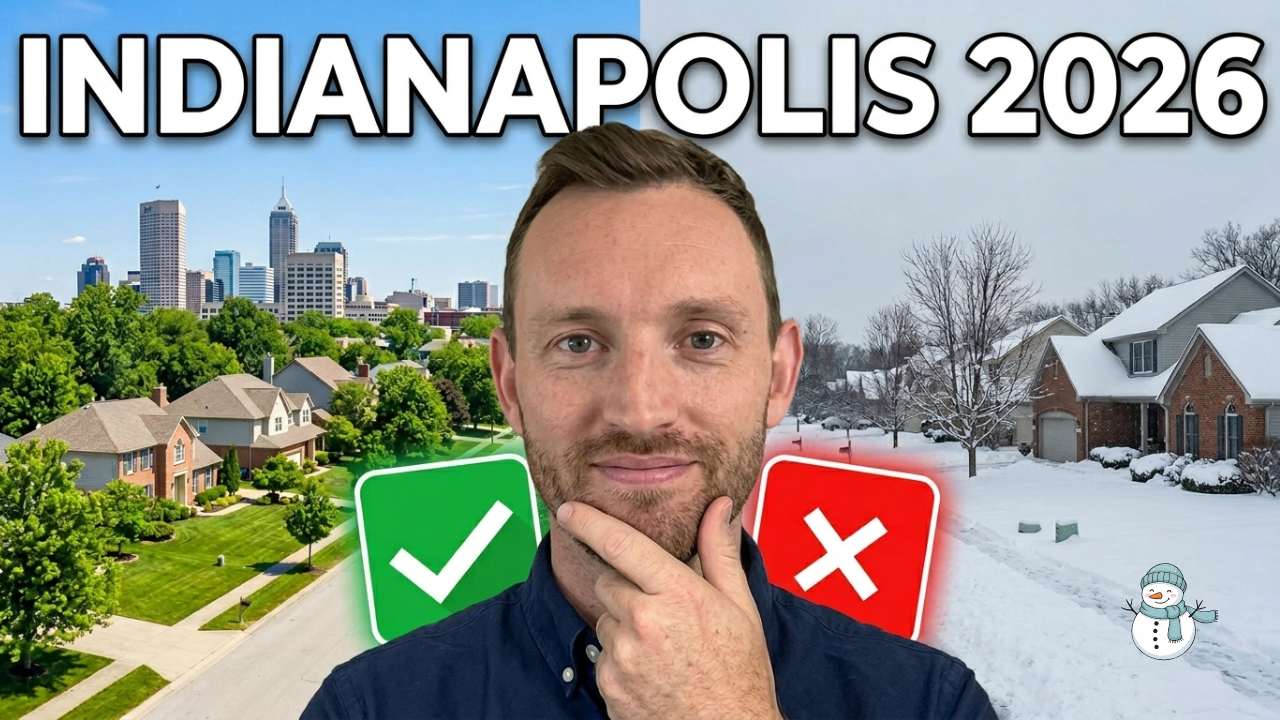
Click HERE for the full video
Thinking about moving to Indianapolis? You're not alone. Indy has recently been ranked as one of the best home-buying markets in the entire country, and it's attracting serious attention from people relocating from high-cost cities across the U.S.
But before you pack up and head to the Crossroads of America, you deserve an honest look at what life here is actually like — the good and the not-so-good. As a local Indianapolis real estate agent who helps 30 to 40 families relocate here every year, I've seen firsthand what makes people fall in love with this city and what catches them off guard.
Let's break it all down.
Table of Contents
- Pro #1: World-Class Events and Sports
- Pro #2: A Top-5 Convention City
- Pro #3: Friendly, Midwestern Hospitality
- Pro #4: Affordable Housing and Cost of Living
- Con #1: Construction and Potholes
- Con #2: Limited Public Transportation
- Con #3: Winter Weather
- Con #4: Flat Landscape, No Ocean or Mountains
- Final Verdict: Is Indianapolis Right for You?
Pro #1: World-Class Events and Sports
Indianapolis is far more than just the Indianapolis 500. The city consistently draws massive national and international events throughout the year, and locals genuinely rally behind them.
Here's a taste of what Indy brings in on a regular basis:
- NBA's Indiana Pacers, NFL's Indianapolis Colts, and WNBA's Indiana Fever
- NCAA Men's Final Four — hosted here most recently just last year
- Big Ten Basketball Tournament — held in Indianapolis nearly every single year
- World Diving Championship Olympic Qualifiers
- NFL Championship Games
If you're moving to Indianapolis, you won't need to travel far or spend a fortune to catch major live events. There is consistently something happening every few months that brings the entire city to life. For families and sports fans especially, this is a major quality-of-life win.
Pro #2: A Top-5 Convention City
Beyond sports, Indianapolis is home to one of the most active convention centers in the United States. The city currently ranks among the top five cities in the country for convention center events — a fact that surprises a lot of people who think of Indy as a smaller Midwestern town.
And it's only getting bigger. The convention center is currently undergoing a major expansion that will bring the total event space to 900,000 square feet. On top of that, the brand-new Signia Hotel — a stunning 26-story glass tower — is set to be completed this fall/winter. The Signia will connect directly to the convention center via elevated walkways, making Indianapolis an even more attractive destination for large national conferences and events.
For residents, this means more energy downtown, more entertainment options, and a city that continues to grow and invest in itself.
Pro #3: Friendly, Midwestern Hospitality
This one is hard to put a price tag on, but it matters more than people expect.
People in Indianapolis are genuinely nice. Midwest hospitality is a real thing — neighbors wave at each other, strangers hold doors, and the overall vibe is a lot more relaxed than what you'll find in major coastal metros. If you're coming from a fast-paced city like Los Angeles, New York, or Chicago, the slower pace and friendlier culture in Indy can feel like a breath of fresh air.
Even driving is noticeably more chill here. Is there traffic? Sure. But it's a different level than what most people moving from California or the East Coast are used to.
Pro #4: Affordable Housing and Cost of Living
This is probably the biggest reason people move to Indianapolis — and honestly, it's the reason I moved back here myself after living in California.
Housing prices in Indianapolis are still genuinely affordable, even as the market has grown. Here's some context:
- A single-family home in Carmel or Zionsville (two of the nicest suburbs in the metro area) will run you around $600,000
- A comparable home in one of the nicest cities in Orange County, California? $1.5 million or more
- You can find solid single-family homes in the $200,000–$300,000 range in many parts of the Indianapolis metro
- If luxury is what you're after, neighborhoods like Williams Creek, Geist, Carmel, Westfield, and Zionsville offer high-end options from $3M to $5M+
No matter your budget, Indianapolis offers a wide range of living situations. That affordability, combined with Indiana's reasonable property taxes and overall cost of living, is a major draw for families and young professionals alike.
I personally came back to Indianapolis from California specifically to buy a home — and it was absolutely the right move.
Con #1: Construction and Potholes
Here's where we get honest. Indianapolis has a lot of ongoing road construction, and it creates a low-level but persistent annoyance for daily drivers.
The good news: the I-65/I-70 north split project is wrapping up in 2026. The not-so-great news: the next big project — the Blue Line BRT (Bus Rapid Transit) construction — is already underway, adding more traffic disruption along Washington Street and the east side.
And then there are the potholes. Indianapolis winters are tough on roads, and the freeze-thaw cycle creates some serious pavement damage every year. Ask any local and they'll tell you: one to two flat tires per year is just a normal part of life here. It's not a dealbreaker, but it's something to budget for.
Con #2: Limited Public Transportation
If you're used to living in a city with a robust rail system, Indianapolis will be a significant adjustment.
Indy has a bus rapid transit system (the Red Line runs from downtown up toward Broad Ripple) but it's not widely used, and there is no full city-wide train or metro system. The bottom line: if you live in Indianapolis, you're almost certainly going to need a car.
The only exception might be if you live and work in downtown Indianapolis specifically, where walkability and rideshare options make car-free living more feasible. But for anyone living outside the immediate downtown core, a personal vehicle is essentially a necessity.
This is a notable difference from larger metros and worth factoring into your relocation decision.
Con #3: Winter Weather
Let's talk about the elephant in the room for anyone moving from a warmer climate.
First, the good news: Indianapolis summers are genuinely beautiful. Warm, green, full of outdoor activities — the city really shines from late spring through early fall. There are tons of green spaces, parks, and outdoor events. It's a great place to be.
But January, February, and March? Those months are rough. Here's what to expect:
- Typically two major cold spurts per winter where temperatures drop close to or below zero degrees
- Each cold snap lasts roughly a week to a week and a half
- The three-month window of cold and grey is a real mental challenge for some people
If you've never dealt with a true Midwest winter, it's worth taking seriously. That said, most long-time residents — myself included — find that once you get through those three months, you barely think about it the rest of the year.
Con #4: Flat Landscape, No Ocean or Mountains
Central Indiana is flat. Very flat. If you're coming from Colorado, the Pacific Northwest, or any coastal area, the landscape is going to be a noticeable change.
There are some gentle hills in Brown County (around Nashville, Indiana and Bloomington) in the southern part of the state, which is genuinely beautiful and worth visiting. On the far south side of Indianapolis and near Fort Benjamin Harrison Park on the east side, you'll find a bit more terrain variation. But broadly speaking, this is farmland country.
There's no ocean, and the nearest beaches are along Lake Michigan — about a three-hour drive north.
Here's the silver lining, though: the same geographic and economic factors that make Indianapolis flat and landlocked are a big part of why housing is so affordable. Cities with mountains and ocean access pay a premium for that scenery. Indianapolis gives you great livability at a fraction of the cost.
Final Verdict: Is Indianapolis Right for You?
Indianapolis is a genuinely great city for the right person or family. Here's a quick summary:
Indianapolis is a great fit if you:
- Want to buy a home without spending a fortune
- Value a friendly, community-oriented culture
- Enjoy sports and live events
- Are looking for a city that's growing and investing in itself
- Don't mind owning a car and can tolerate flat terrain
Indianapolis might not be the best fit if you:
- Need a walkable, car-free lifestyle
- Want mountains, beaches, or dramatic scenery nearby
- Can't handle a real Midwest winter
- Are attached to big-city public transit infrastructure
For most people relocating from high-cost states like California, New York, or Illinois, Indianapolis delivers an excellent quality of life at a price that's hard to beat anywhere else in the country.
Thinking About Moving to Indianapolis?
I'm Sean Hartwick — also known as The 317 Agent on Instagram — and I specialize in helping families relocate to the Indianapolis area. I work directly with every client (no team handoffs), and I'd love to be a resource for you and your family as you navigate this move.
Whether you have questions about neighborhoods, school districts, the home buying process, or just want to know what area is the best fit for your lifestyle, feel free to reach out. My personal cell and email are always available — just look in the description or contact me directly.
Let's get you home.
Sean Hartwick is a licensed real estate agent serving the Greater Indianapolis area. Follow him on Instagram @317agent.